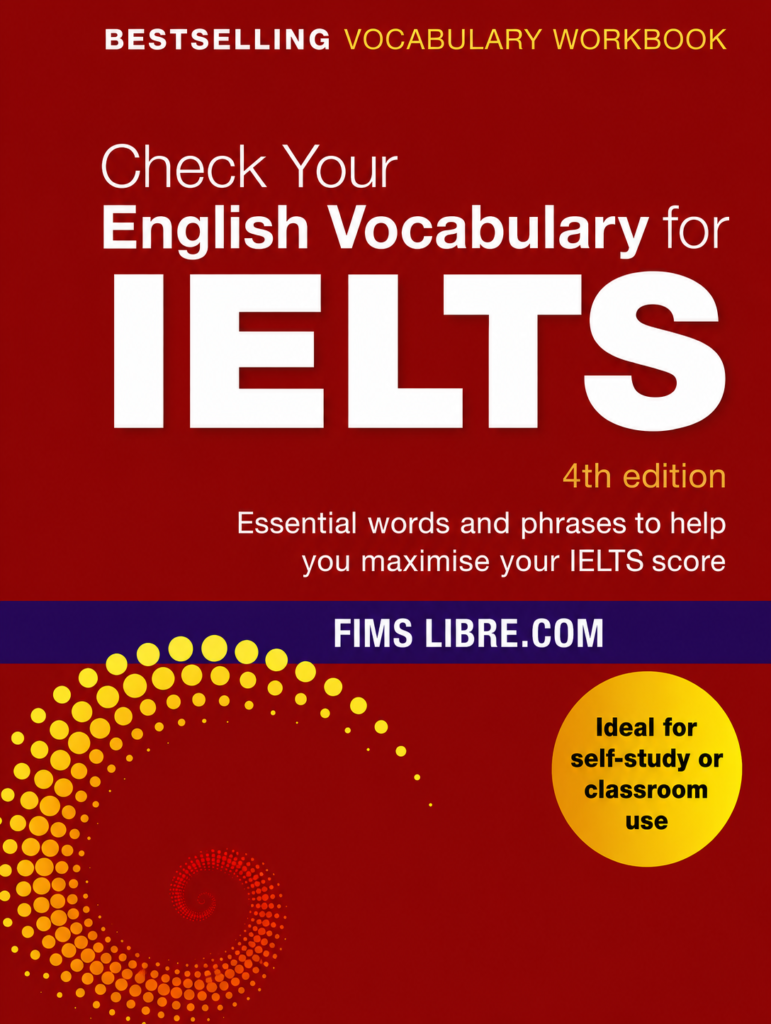
Honestly, studying for the IELTS can feel like trying to run a marathon in quicksand. There is just so much material out there, and a lot of it is, frankly, incredibly dry. So when I picked up the 4th edition of Check Your English Vocabulary for IELTS by Bloomsbury, I wasn’t expecting to be blown away. It’s a vocabulary workbook, after all. But after spending some quality time flipping through its pages and actually working through the exercises, I figured it was worth sitting down and writing out some thoughts for anyone else currently staring down this exam.
📖 About This Book
So, what are we actually looking at here? This is a practical, fill-in-the-blanks style workbook published by Bloomsbury. It’s sitting right there on the cover—it claims to offer “essential words and phrases” to help maximize your score, and mentions it’s ideal for both self-study and classroom use. It’s not a massive, intimidating textbook that you can use as a doorstop. It’s relatively slim, focused, and pretty much gets straight to the point without a lot of fluff.
🧠 Book Summary
The main idea behind this book is pretty straightforward: it wants to close the gap between knowing “general” English and knowing the specific type of language the IELTS examiners are looking for. It doesn’t just give you a list of words to memorize (which I hate, by the way—who actually learns that way?). Instead, it breaks things down into two main areas. First, it tackles general vocabulary topics like change, geography, or education. Then, it dives into topic-specific vocabulary, which is super useful for the writing and speaking modules where you might suddenly have to write an essay about the environment or space exploration.
⭐ Key Highlights
- The layout isn’t overwhelming: Each topic is usually just a page or two. You can do a section in 15 minutes over coffee.
- Structured exercises: Instead of just definitions, you get crosswords, gap-fills, and matching exercises.
- To be fair, some of the puzzles feel a bit like high school homework, but they do force the words into your brain.
- Focus on collocations: This is huge. It shows you which words naturally go together, which is exactly how you get those higher band scores in vocabulary.
🎯 What You Will Learn
If you actually put in the work and don’t just let it collect dust on your desk, you’re going to get a much better grip on academic English. You’ll stop using the word “good” or “bad” fifty times in an essay. It teaches you how to express cause and effect, how to structure an argument using words like furthermore or in contrast without sounding incredibly robotic, and how to talk about trends in graphs (crucial for Task 1 of the academic writing section).
👥 Who This Book Is For
I’d say this is a sweet spot for anyone currently sitting around a Band 5.5 or 6.0 who is desperately trying to push into the 7.0 or 7.5 range. If your grammar is mostly fine but you find yourself running out of things to say—or using the same vocabulary over and over—this will help. It’s also great for self-study. You don’t really need a teacher to guide you through it because the answer key at the back is pretty comprehensive. However, if you are a complete beginner, this might feel a bit like jumping into the deep end.
💡 My Honest Opinion
Alright, let’s get into the real talk. I actually quite like this book, but it isn’t perfect.
What I love about it is the sheer practicality. I feel like a lot of IELTS prep material tries to teach you the entire English language in three weeks. This book doesn’t do that. It knows it’s a tool for an exam. The exercises are varied enough that you don’t fall asleep, and the focus on academic phrases is genuinely useful for the writing section. I noticed that the vocabulary chosen is highly realistic; these are words that actually show up in the reading passages.
But, here is the annoying part. I don’t know why, but sometimes the book feels a little disjointed. Because it relies so heavily on fill-in-the-blank exercises, you can sometimes guess the answer just by looking at the context clues of the sentence, without fully grasping the deeper meaning of the word. Also, it’s a workbook. If you don’t actively practice using these words in your own speaking and writing practice, you’ll just forget them three days later. It requires you to do the extra legwork of actually using the vocabulary in context.
Also, a tiny nitpick—the design is a bit plain inside. It’s very functional, very black-and-white, which some people might find a bit tedious after an hour of studying.
📥 Final Note
At the end of the day, Check Your English Vocabulary for IELTS is a solid, reliable workhorse of a book. It’s not going to magically grant you a Band 8 overnight, but if you’re looking for a structured, no-nonsense way to expand your vocabulary and get familiar with academic phrasing, it’s absolutely worth having on your desk. Just make sure you keep a notebook handy to actually practice writing your own sentences with the words you learn.
📥 How to Download This Book
Click the button below to download this ebook in PDF format.
📚 Related Books
Join Our Facebook Learning Groups
🇩🇪 Learn German Free 🇬🇧 English Learning Group 🇪🇸 Spanish Learning GroupJoin our educational Facebook communities to improve your language skills, practice daily conversations, and connect with learners from around the world.