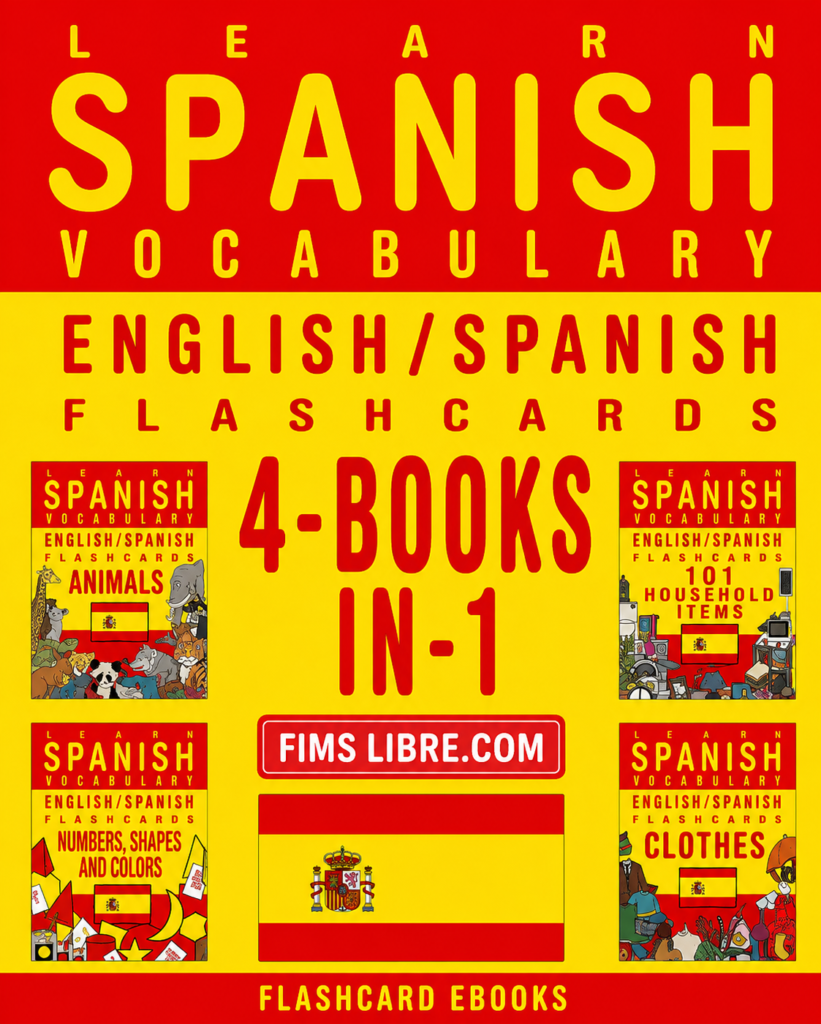
First Impressions
I’ll be honest: when I picked up Learn Spanish Vocabulary: English/Spanish Flashcards, I wasn’t expecting much more than a digital set of index cards. We’ve all seen a million of these, right? It’s a 4-in-1 collection that covers animals, household items, clothes, and numbers/shapes/colors. My initial thought was that it would be another dry, overly academic list that I’d end up closing after five minutes because it felt too much like studying for a test.
What surprised me most, though, was how straightforward it actually is. It’s not trying to be a complex grammar guide; it just wants to get words into your brain through simple repetition.
What’s This Book Really About?
If I’m being realistic, this isn’t a book you “read” in the traditional sense. It’s a visual vocabulary builder. About 40% of the content—and really, the core purpose of the whole thing—is just an overview of essential nouns organized into clear categories. You get the English word, the Spanish equivalent, and a simple illustration to go with it.
It covers a lot of ground quickly. You’ve got everything from “bat” (el murciélago) to “refrigerator” (el refrigerador). It’s essentially a digital reference guide for beginners who are tired of boring word lists and want something that puts a picture to the name.
Things That Stood Out to Me
I found myself liking the categorization. Having the items grouped into specific themes like “Clothes” or “Household Items” makes it way easier to actually retain the information. If you’re trying to learn household objects, you don’t want to be flipping through pages of animals, so that structure works well.
To be fair, the illustrations are a bit quirky. They look like simple, hand-drawn cartoons. At one point, I thought they might be a bit too basic, but then I realized that for vocabulary retention, simple is often better. It doesn’t distract you; it just provides the visual anchor you need to remember that la mesa is a table.
A Couple of Weak Spots
If I’m being critical, there are a few things that felt a little light. This isn’t a book for anyone looking to have a conversation. It doesn’t teach you how to conjugate verbs or structure a complex sentence. It’s strictly for vocabulary expansion.
Also, because it’s a collection of flashcards, it lacks the context that you’d get from a real story or a dialogue-based book. You learn the word for “screwdriver” (el destornillador), but you don’t necessarily learn how to use it in a sentence about fixing a shelf. It’s a tool, not a full-course meal.
What I Took Away From It
Honestly, I think the value here is in the “4-in-1” convenience. It’s surprisingly handy to have these lists all in one place on a phone or tablet. When I had five minutes of downtime waiting for coffee, I could just pull it up and refresh my memory on the numbers or the names of different animals. It’s not going to make you fluent overnight, but it’s a solid, no-nonsense way to fill in the gaps in your vocabulary.
Final Thoughts
Is it worth your time? If you are a complete beginner and you’re frustrated by “learning methods” that are too complicated, then yes. It’s simple, it’s visual, and it gets straight to the point. Just don’t go into it expecting a deep dive into Spanish culture or language mechanics. It’s exactly what it says on the cover: a collection of English/Spanish flashcards to help you memorize the basics.
Maybe it’s just me, but I prefer having a handful of these focused resources rather than one giant, intimidating textbook. It’s a low-pressure way to learn, and sometimes, that’s all you really need.
📚 Related Books
Spanish Short Stories For Beginners More Than 500 Spanish Vocabulary Book
View Book →
Practising German grammar workbook
View Book →
Learn Spanish Vocabulary Book
View Book →
The Land of Stories The Enchantress Returns
View Book →
COLLINS EASY LEARNING – Complete Spanish Grammar + Verbs + Vocabulary
View Book →Join Our Facebook Learning Groups
🇩🇪 Learn German Free 🇬🇧 English Learning Group 🇪🇸 Spanish Learning GroupJoin our educational Facebook communities to improve your language skills, practice daily conversations, and connect with learners from around the world.