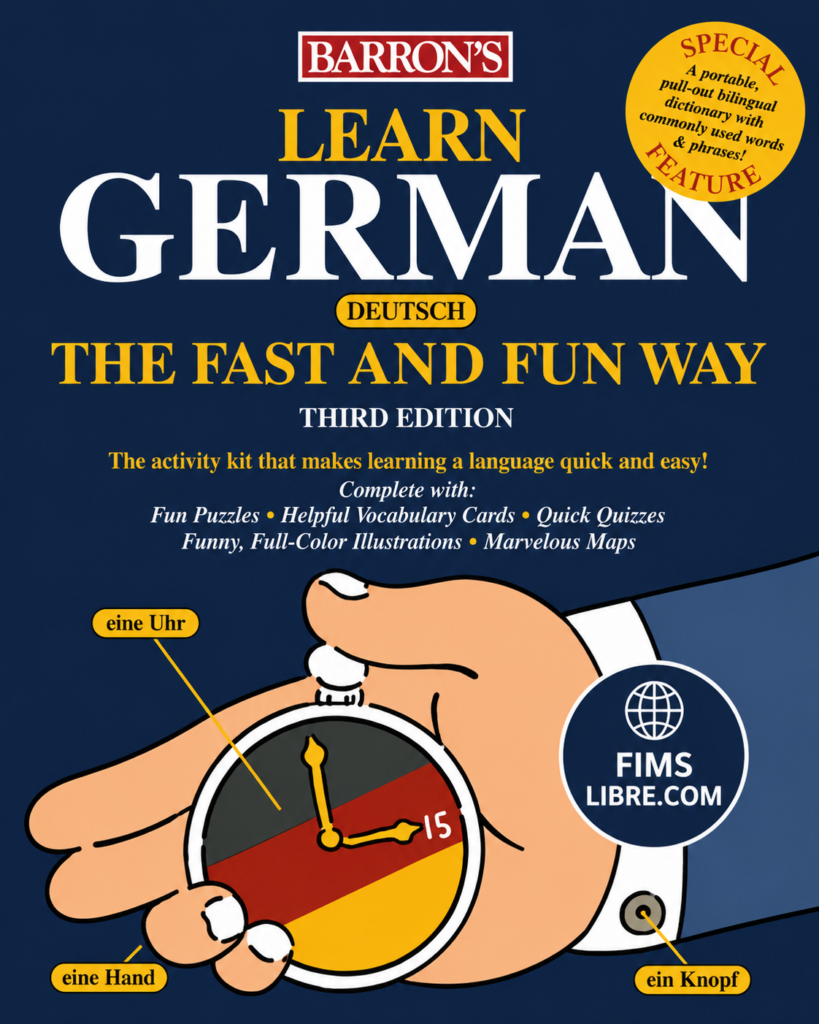
My Reading Experience
I picked up Learn German the Fast and Fun Way because I wanted something that felt less intimidating than a traditional language textbook. The title made a pretty bold promise, and honestly, I was a little skeptical. I’ve tried language books before that claimed learning would be “easy,” only to discover pages filled with grammar charts that made me want to close the book after twenty minutes.
This one turned out to be different in a few important ways. It still teaches the fundamentals, but it does so with a lighter approach that made me want to keep going instead of treating every lesson like homework.
What Makes It Different?
The biggest difference I noticed is the overall tone. Instead of feeling like a classroom lecture, the book tries to keep the learning process relaxed. There are plenty of examples, activities, and little exercises that encourage you to think rather than simply memorize lists of words.
I also appreciated that vocabulary is introduced alongside practical situations instead of being presented as endless isolated lists. That made new words easier to remember because they actually had a purpose. I found myself recalling phrases more naturally after seeing them used in context.
Another thing I liked was that the lessons gradually become more challenging. I never felt completely lost, even when new grammar appeared. Looking back, that steady progression probably kept me motivated more than anything else.
A Few Things I Liked
One of my favorite parts was how approachable the writing felt. Some language books seem determined to impress readers with technical explanations, but this one focuses more on helping you communicate.
A few things stood out during my reading:
- Lessons are broken into manageable sections.
- Grammar is introduced step by step instead of all at once.
- Exercises encourage active participation rather than passive reading.
- Everyday vocabulary receives more attention than obscure expressions.
- The pace feels suitable for complete beginners.
I wasn’t expecting to enjoy the review sections as much as I did. Revisiting earlier material helped reinforce what I had already learned without making the repetition feel boring.
A Couple of Weak Spots
To be fair, I don’t think the title should be taken too literally. Learning any language takes time, and German certainly isn’t an exception. Reading this book alone won’t suddenly make someone fluent.
There were also moments when I wished certain grammar topics had been explained in greater detail. Beginners will probably appreciate the simplicity, but curious readers may eventually want additional resources to understand why certain rules exist.
Maybe it’s just me, but I also felt that some exercises could have included a few more real-world conversations. While the examples are useful, I occasionally wanted longer dialogues that showed how everything fits together naturally.
What I Took Away From It
What surprised me most wasn’t how many German words I learned—it was how much more confident I became about starting conversations. Before reading, German seemed much more intimidating than it does now.
The book does a good job of reducing that fear by breaking the language into small, achievable pieces. Instead of worrying about mastering every grammar rule immediately, I found myself focusing on communicating simple ideas first.
That approach worked well for me because it made progress feel visible. Even small improvements became encouraging.
I finished each study session feeling like I had actually learned something practical instead of simply memorizing information that I would forget the next day.
Who Will Probably Enjoy This
I think this book is best suited for complete beginners or people returning to German after a long break. It doesn’t assume extensive previous knowledge, which makes it approachable from the very beginning.
Travelers preparing for a trip, students looking for extra practice, or anyone interested in learning conversational German at a comfortable pace will probably get the most value from it.
If someone is already comfortable with intermediate German grammar, though, they may outgrow this book fairly quickly. It serves as a foundation rather than a comprehensive reference.
Final Thoughts
If I’m being realistic, no single book can teach an entire language on its own. Real progress still comes from regular practice, listening to native speakers, and using the language whenever possible.
That said, I genuinely enjoyed working through this one. It doesn’t try to overwhelm readers with unnecessary complexity, and it succeeds in making German feel much more approachable than I expected.
By the time I reached the later chapters, I wasn’t thinking about how difficult German might be anymore. Instead, I was simply curious to learn the next lesson. For me, that’s probably the strongest compliment I can give a beginner language book.
📚 Related Books
Learn Spanish Vocabulary Book
View Book →
Practising German grammar workbook
View Book →
COLLINS EASY LEARNING – Complete Spanish Grammar + Verbs + Vocabulary
View Book →
Learn Spanish In Just 15 Minutes A Day Book
View Book →
Spanish Short Stories For Beginners More Than 500 Spanish Vocabulary Book
View Book →Join Our Facebook Learning Groups
🇩🇪 Learn German Free 🇬🇧 English Learning Group 🇪🇸 Spanish Learning GroupJoin our educational Facebook communities to improve your language skills, practice daily conversations, and connect with learners from around the world.