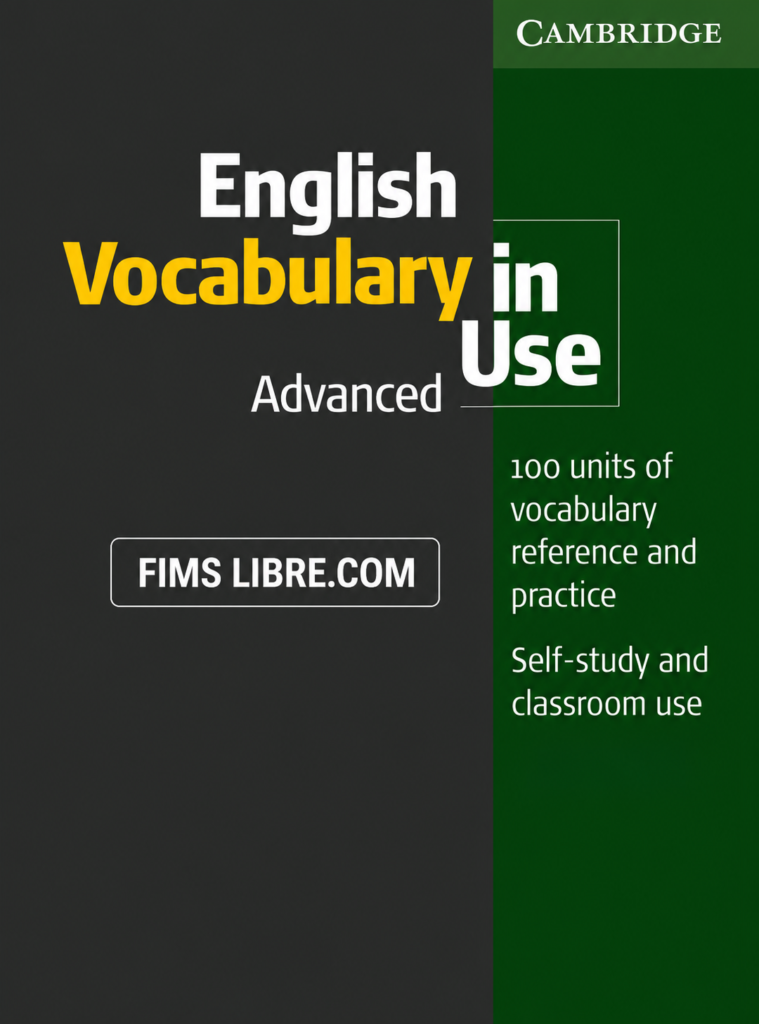
Overview of This Book
I’ve just finished working through Cambridge English Vocabulary in Use (Advanced), and honestly, it felt like a bit of a marathon. I don’t say that to sound dramatic—it’s just that this book is packed with so much dense, high-level vocabulary that you can’t exactly fly through it.
The book is organized into around one hundred units, with each lesson concentrating on a particular vocabulary topic. Some chapters deal with formal and informal language, while others explore idioms, collocations, phrasal verbs, fixed expressions, and words that are often confused.
Each unit follows a simple pattern. New vocabulary is introduced on one page, and exercises appear on the opposite page. I found this layout surprisingly comfortable because I never had to flip back and forth searching for explanations.
Instead of asking readers to memorize definitions, the exercises encourage using new vocabulary in realistic situations. Sometimes you complete sentences, sometimes you choose between similar expressions, and sometimes you rewrite examples using newly learned words. It keeps the learning process active rather than passive.
A Quick Walk Through the Content
If you’re expecting a typical textbook that just lists vocabulary by topic, this isn’t it. The book actually starts with a heavy emphasis on how to learn, which I initially thought was a bit dry. It spends the first eight units talking about things like polysemy, register, and collocation. Honestly, I almost skipped these, but I’m glad I didn’t. Learning the difference between “the real thing” and “the genuine article” (Unit 4) or understanding why “fair” has so many different meanings (Unit 5) actually changed how I look at words I thought I already knew.
After those foundational units, it dives into the thematic sections—things like Work and Study, People and Relationships, The Environment, and Technology. It covers a massive amount of ground. You aren’t just getting a list of words; the units break down prefixes, suffixes, idiomatic expressions, and even how English is used in things like newspaper headlines or academic writing.
Things That Stood Out to Me
I picked up English Vocabulary in Use: Advanced expecting another vocabulary book filled with endless word lists that I’d probably forget after a few days. Instead, I ended up spending much more time with it than I originally planned. It doesn’t try to impress readers with complicated explanations or unnecessary theory. It simply focuses on helping advanced learners use English more naturally, and for the most part, it succeeds.
What really surprised me was the focus on register. I’ve always struggled with sounding too formal in casual settings or too informal in professional ones. The book provides these great tables comparing neutral, formal, and informal ways to say the same thing (like television vs. the box/telly in Unit 7).
I also appreciated the “human” touch in the exercises. The authors don’t just give you a list to memorize. Instead, they constantly push you to:
- Use a learner’s dictionary to find extra collocations.
- “Personalize” the words by writing sentences about your own life.
- Group words in ways that make sense to you, not just how they’re grouped in the book.
Some Personal Thoughts
To be fair, there were parts that felt repetitive. Some of the exercises in the later units felt like I was doing the same matching task I’d done fifty times before. When I got to the section on Travel, I found myself zoning out a little because some of the vocabulary felt very specific to British English or contexts I just don’t run into often.
Also, I don’t know why, but I found the sections on phrasal verbs particularly challenging. It’s not that the explanations weren’t clear—they were—but phrasal verbs are just notoriously slippery to remember. I had to go back and revise those units three or four times to actually make them stick.
Is It Worth Your Time?
If you’re looking for a quick fix or a list of “top 100 words to know,” this definitely isn’t it. But if you’re actually interested in the mechanics of English—why we say things the way we do, or how to distinguish between words that seem to mean the same thing—it’s incredibly practical.
I kept noticing that the book forces you to be active. You can’t just read it; you have to do the work. One thing that stayed with me after finishing was the idea of “connotation.” I never really gave much thought to how a word like “cowboy” can have such a negative, dishonest association when used to describe a builder (Unit 8). It made me realize how much “hidden” meaning I was missing in my own reading.
Final Thoughts
Looking back, I think my favorite part was realizing how much of the vocabulary I was “guessing” at before I actually read this. I definitely feel more confident writing now because I have a better sense of which words are “academic” versus which ones are just standard. It’s not a perfect book—it can be a bit dry and the sheer volume of information is intimidating—but if you’re serious about moving from “advanced” to “fluent,” it’s a solid resource to have on your shelf.
It didn’t transform my English overnight, but it definitely gave me the tools to fix some of the bad habits I didn’t even know I had.
Overall, I came away feeling that I had learned more than just new words. I gained a better sense of how advanced English is actually used, which is something vocabulary lists alone rarely accomplish. If you’re willing to work through it steadily rather than rush, there’s a lot here that can genuinely improve the way you read, write, and express yourself in English.
Join Our Facebook Learning Groups
🇩🇪 Learn German Free 🇬🇧 English Learning Group 🇪🇸 Spanish Learning GroupJoin our educational Facebook communities to improve your language skills, practice daily conversations, and connect with learners from around the world.